
The holiday jewelry season is not won in December. It is won months earlier, when a brand decides how it will produce, store, package, and deliver every order that arrives during peak gifting weeks.
By the time shoppers begin looking for proposal rings, anniversary gifts, milestone pieces, and stocking-ready jewelry, the operational decisions that determine success have already been made.
The strongest holiday creative cannot compensate for a bestseller that sells out too early, the wrong inventory mix, or an order that arrives late in generic packaging.
Holiday readiness is not simply about buying more stock. It requires a plan that aligns production capacity, inventory, fulfillment, distribution, and delivery expectations.
At MJJ Brilliant, we help brands build more flexible models by combining manufacturing with fulfillment, dropshipping, and distribution support under one operational relationship.
Why Holiday Demand Is Different for Jewelry
Jewelry creates a specific kind of peak-season pressure. A late delivery is not just an inconvenience when the piece is intended for a proposal, anniversary, or family celebration. It can become a missed moment that damages trust in the brand.
The category also carries higher operational stakes than most consumer products:
- High-value inventory: Each piece requires secure handling, accurate tracking, and shipping safeguards appropriate to its value.
- Complex SKUs: One ring design can become dozens of variations based on size, karat, metal color, stone specification, engraving, or personalization.
- Gift-ready expectations: Customers expect a polished experience: branded boxes, pouches, care cards, certificates, gift notes, and secure presentation.
- Unpredictable demand: A viral post, influencer feature, paid campaign, or retailer reorder can suddenly accelerate demand for a single style.
- Limited recovery time: If a key item goes out of stock in December, there may be no meaningful opportunity to recover that sale before the gifting window closes.
Holiday planning is therefore not just about having more inventory. It is about building the infrastructure to respond when demand does not follow the forecast.
Start With a Production Plan
Forecasting is essential, but a forecast alone is not a holiday operating plan. We recommend building scenarios around three demand levels:
- Base demand: The expected volume based on prior sales, current traffic, and retailer commitments.
- Strong demand: The upside scenario if campaigns outperform or hero styles gain traction.
- Bestseller replenishment: A contingency plan for the styles that sell through faster than expected.
Start by identifying the products most likely to carry the season: proven bestsellers, accessible gifting price points, core designs, and easy-to-size categories such as earrings, pendants, and bracelets. These are often the right products to pre-produce and hold for immediate fulfillment.
Other products need a more flexible approach. Variable ring sizes, engraving, personalized designs, new launches, and less predictable colorways may be better suited to made-to-order production.
The goal is to reserve inventory where immediate shipping matters while retaining capacity for the areas where demand is less certain.
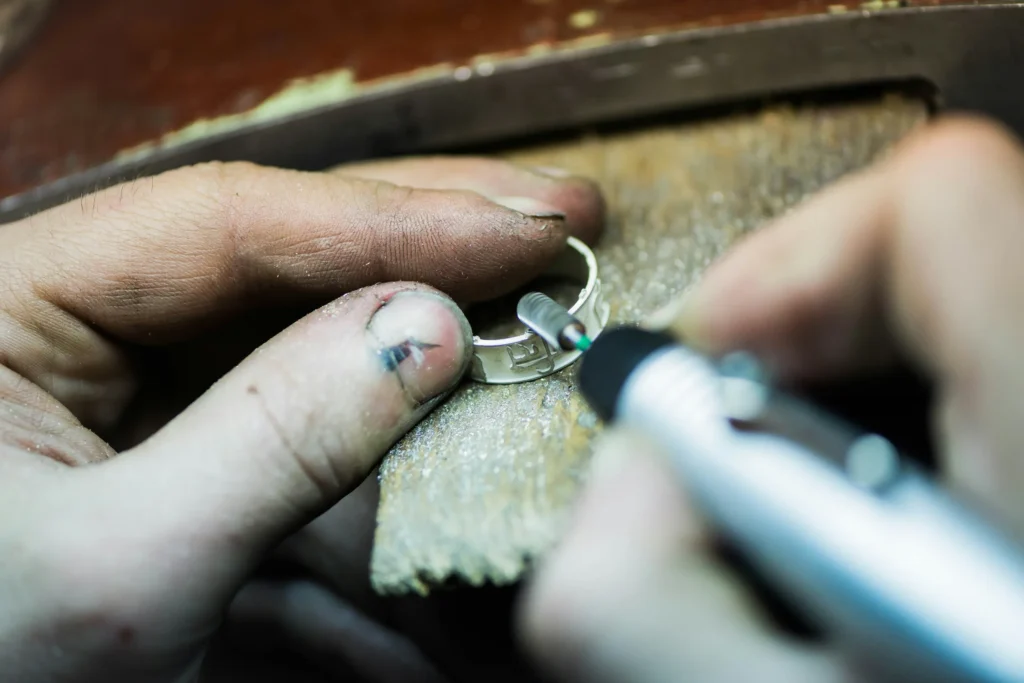
MJJ supports this end-to-end flow, from CAD/CAM and casting through stone setting, finishing, packaging, and shipping.
Our broader custom jewelry manufacturing process gives brands a single production foundation rather than a series of disconnected vendors. That matters in peak season, when every handoff adds the potential for delay or error.
Use a Hybrid Inventory Model
The two biggest holiday inventory mistakes are easy to name: under-buying the pieces customers already want, and over-buying trend-led styles that must be discounted in January.
A hybrid model helps brands avoid both.
| Product type | Recommended holiday approach |
| Proven bestsellers | Pre-produce and hold inventory for immediate fulfillment |
| Common ring sizes | Hold a controlled quantity; replenish against sell-through |
| Engraved or personalized pieces | Produce made-to-order |
| New or trend-driven styles | Run a small test batch or use dropshipping before deeper commitments |
| Wholesale reorders | Reserve capacity and establish replenishment rules in advance |
This approach gives brands speed where speed is commercially essential and flexibility where uncertainty is highest. It also protects working capital.
Instead of committing deeply to every style, a brand can allocate inventory based on confidence level, sales history, and production complexity.
That is where no-MOQ, made-to-order manufacturing becomes especially useful. It can support prototypes, small launches, custom orders, and replenishment programs, subject to approved specifications, production capacity, and material availability.
For holiday planning, the value is not “produce everything on demand.” It is knowing which items should be stocked and which can remain flexible.
What a Holiday Fulfillment Partner Should Handle
Holiday fulfillment is far more than putting jewelry into a box. A capable jewelry fulfillment partner protects the product, the delivery promise, and the unboxing experience equally.
At minimum, that includes:
- Inventory receiving and SKU reconciliation: Confirming quantities, sizes, metal types, stone specifications, and product variants as goods arrive from production.
- Quality control before dispatch: Checking finish integrity, stone security, plating consistency, product accuracy, and packaging readiness before an order goes out.
- Branded packaging: Preparing the exact customer experience your brand requires, including boxes, pouches, inserts, certificates, care cards, ribbons, anti-tarnish materials, and gift notes.
- Accurate picking and tracked shipping: Processing DTC orders correctly and providing customers with appropriate tracking and service updates.
- High-value safeguards: Supporting documented chain of custody, declared-value procedures, insurance, RJC certification and signature confirmation where appropriate.
- Returns triage: Inspecting returned items to determine whether they are restock-ready, need cleaning or repair, or should be removed from sellable inventory.
- Peak-season communication: Establishing clear production, order, and shipping cutoffs before volume accelerates.
A generic 3PL may be able to ship a parcel. But fine jewelry requires the level of handling, QC, and presentation that protects the brand at every touchpoint. For a deeper overview, see our guide to choosing a jewelry fulfillment partner for dropshipping and distribution.

When Dropshipping Is the Smarter Strategy
B2B jewelry dropshipping is not the generic marketplace model many brands associate with long lead times and anonymous packaging.
In a brand-controlled setup, the customer orders through your e-commerce site or retail channel, and MJJ produces or pulls the approved item from inventory, packages it in your branded materials, and ships it directly to the customer.
The customer sees your brand. They receive your packaging and your product presentation. You avoid the warehouse commitment, packing labor, and inventory exposure that can create bottlenecks in the busiest weeks of the year.
Dropshipping is especially useful for:
- Personalized or engraved pieces
- Made-to-order ring sizes
- Items with numerous metal, stone, or finish variations
- New styles that have not earned a deep inventory commitment
- Extended online assortments that increase gifting choice without increasing storage needs
It should not replace stocked inventory for proven bestsellers where immediate shipping is central to conversion. Instead, it works best as part of the hybrid model: stock the predictable winners and use dropshipping to expand assortment without overcommitting capital.
Retail Distribution Needs Its Own Plan
For wholesale and retail brands, holiday readiness is not only about getting product made. It is about getting the right product to the right door, in the right format, at the exact moment the retailer needs it.
Retail accounts may require specific routing instructions, UPCs, labels, carton markings, packing slips, advance ship notices, and delivery windows. Missing a requirement can create chargebacks, delayed floor placement, or lost sales during the most important period of the year.
Brands supplying multiple doors need visibility into inventory by SKU, production capacity, retailer order status, and replenishment needs.
When production and distribution sit under one operational ecosystem, a sell-through signal can move more directly into replenishment planning without the brand manually coordinating factories, warehouses, and carriers.
That model is especially useful for brands looking to expand geographically. Our guide on scaling a jewelry brand nationwide without new stores explores how centralized production and distribution can support growth without creating unnecessary fixed overhead.
Holiday Readiness Checklist
Before peak season begins, confirm that your team has:
- Finalized hero SKUs and holiday assortment priorities
- Reviewed prior-year sell-through by style, size, metal, and price point
- Categorized items for pre-production, made-to-order, or dropshipping
- Confirmed production capacity and replenishment timelines
- Established final order, production, and shipping cutoffs
- Counted branded packaging inventory and replenishment materials
- Reviewed high-value shipping, insurance, and signature requirements
- Tested SKU accuracy and order-routing workflows
- Confirmed retailer-specific routing, labeling, and documentation rules
- Prepared a returns, repair, and customer-service plan for January
Build a Holiday Plan That Can Flex
Holiday success does not come from forecasting perfectly. It comes from building a system that can flex when demand changes.
The right model combines pre-produced inventory for reliable bestsellers, made-to-order flexibility for variable products, branded fulfillment for DTC orders, dropshipping for inventory-light expansion, and distribution support for retail accounts.
When these functions are coordinated through one partner, brands reduce handoffs, avoid inventory errors, and move faster when a product starts to outperform.
Holiday demand is coming. Talk to MJJ about preparing your holiday production and fulfillment plan, and build an operating model that can scale when demand does.