Jewelry fulfillment is not a Shopify plugin problem. It is a chain‑of‑custody problem, a brand integrity problem, and a scalability problem, and most generic logistics solutions were never built to solve any of them.
High unit values demand tighter controls than apparel. Branded presentation has to be perfect every time. Wholesale and multi‑door distribution bring routing guides, EDI, ticketing, and chargebacks into the picture.
This article lays out what a true B2B jewelry fulfillment partner does, how dropshipping actually works for jewelry brands, and how to evaluate a partner before you sign.
At MJJ Brilliant, production and fulfillment run under one relationship — from USMCA-qualified production in Mexico through to final delivery, whether that is a single DTC order or a multi‑door retail rollout.
Why Generic Logistics Partners Fall Short for Jewelry Brands
Standard 3PLs and off‑the‑shelf fulfillment apps are optimized for high‑volume, low‑value products. Fine jewelry breaks that model on several fronts.
- High‑value item handling
A ring or tennis bracelet can represent thousands of dollars in a single SKU. That demands secure storage areas, controlled access, detailed chain‑of‑custody, and processes that treat each piece as an individual asset, not just a bin location. - SKU accuracy requirements
Jewelry SKUs are multidimensional: metal type, karat, color, stone type, size, and finish. Picking the wrong metal or karat isn’t a simple exchange — it can be a compliance issue and always a trust failure. - Packaging complexity
Fine jewelry orders often require a specific sequence: branded box, pouch, insert, anti‑tarnish, care card, maybe a certificate. Wholesale accounts may require different packaging standards than DTC. Generic 3PLs can technically do this, but only with custom projects that add cost and friction. - Returns and damage handling
A returned piece needs visual inspection by someone who knows what to look for — loose stones, bent prongs, worn plating — before being restocked or routed to repair. A scan‑in‑scan‑out process is not enough. - Wholesale compliance
Retail chains expect strict adherence to routing guides, label formats, ticketing rules, and delivery windows. Missed requirements can trigger retailer chargebacks that quietly erode margins.
These are not edge cases. They are daily realities for fine jewelry brands. They call for a fulfillment partner built around this category, not a generalized warehouse trying to adapt.
What a B2B Jewelry Fulfillment Partner Actually Handles
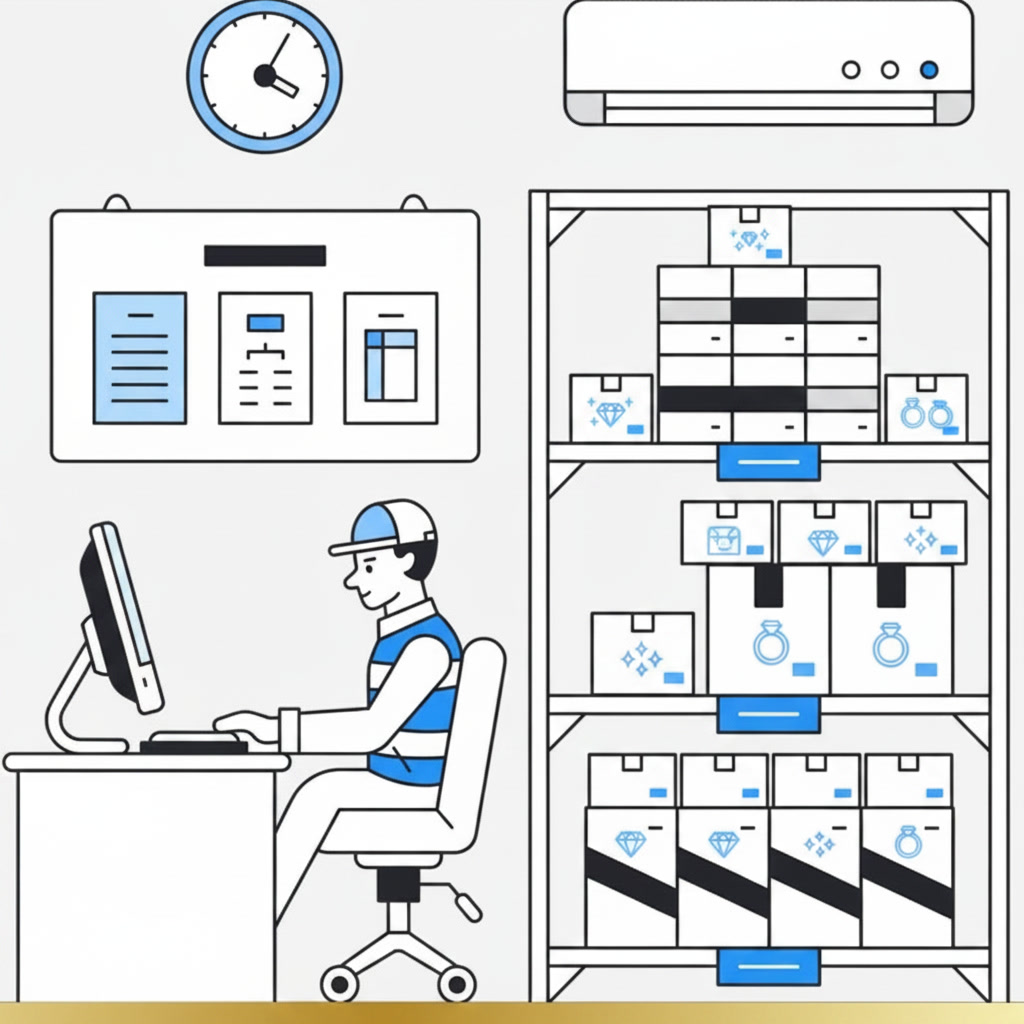
A true jewelry fulfillment partner acts as an operational extension of your brand, not just a shipping room. At a minimum, they should manage the following.
Receiving and inventory intake
Finished pieces arrive from production — in our case, directly from our Mexico facility, without a separate third-party 3PL handoff — and are counted, verified against purchase orders, and logged into inventory by SKU. Any discrepancy in quantity, spec, or finish is identified at intake rather than at pick time.
QC at intake
Each piece is inspected for finish integrity, stone security, plating consistency, and packaging readiness before it enters sellable stock. Items that do not pass go straight into a repair or rework queue rather than being shelved.
Branded packaging and presentation
Orders are packed according to brand‑defined standards: the right box, pouch, tissue, anti‑tarnish strip, care card, certificate, and any promotional materials. Wholesale orders may add UPC labels, hangtags, poly‑bag specs, and carton markings required by each retailer. Pack stations follow documented brand profiles so nothing is improvised.
Order routing and dispatch
- DTC orders are picked, packed, and shipped with tracking, using either your carrier accounts or the fulfillment partner’s.
- Wholesale orders follow retailer routing guides, with correct documentation, labeling, and carton structure so they clear quickly and avoid chargebacks.
- Dropship orders can be produced on demand and shipped directly, reducing or eliminating finished-goods inventory for eligible made-to-order programs.
Chain‑of‑custody documentation
Every piece is traceable from intake to dispatch through SKU, order number, and shipment record. High‑value orders can be tied to signature requirements, declared values, and insurance documentation.
Returns handling
Returns are received and inspected. Each item is assessed as restock‑ready, repair‑required, or write‑off. You see condition‑based feedback, not just a quantity adjustment. For pieces needing repair, a manufacturer‑integrated partner can route them straight into the bench workflow.
This is what wholesale jewelry fulfillment looks like when it is designed for the category instead of retrofitted.
Jewelry Dropshipping: What It Means in a B2B Context
“Dropshipping” has picked up the wrong connotation for many serious brands because most people associate it with generic, low‑quality products and long delivery times. B2B jewelry dropshipping is a different model.
How B2B jewelry dropshipping works
- You list products on your site, wholesale portal, or retailer dot‑com.
- When an order comes in, it is passed to the fulfillment partner.
- We produce (for made‑to‑order pieces) or pull from your dedicated inventory and ship directly to the end customer or retail DC.
- The order goes out in your packaging, under your brand name; the customer never sees the partner behind it, as MJJ Brilliant offers white-label packing slips, labels, return addresses, and notifications across both DTC and retailer dropship programs.
From the buyer’s point of view, this is indistinguishable from you running your own warehouse — except you are not holding stock, staffing a facility, or negotiating carrier contracts.
How this differs from consumer dropshipping apps
Consumer dropshipping platforms ship unbranded goods with slow lead times and minimal QC. In a B2B jewelry dropshipping setup, the opposite is true: pieces are manufactured to your spec, pass jewelry‑grade QC, and ship on defined SLAs in full brand packaging. It is a third‑party logistics solution built specifically for fine jewelry.
Where B2B dropshipping is strongest
- Launching new designs without inventory risk.
- Testing new collections, materials, or price points on your site or through select retailers.
- Supporting made‑to‑order or personalization programs where each piece is produced against a customer order.
Here, dropshipping is an extension of your manufacturing model, not a shortcut around it — especially when it is combined with no‑MOQ production.
Wholesale Distribution: Serving Retail Accounts Without the Logistics Complexity
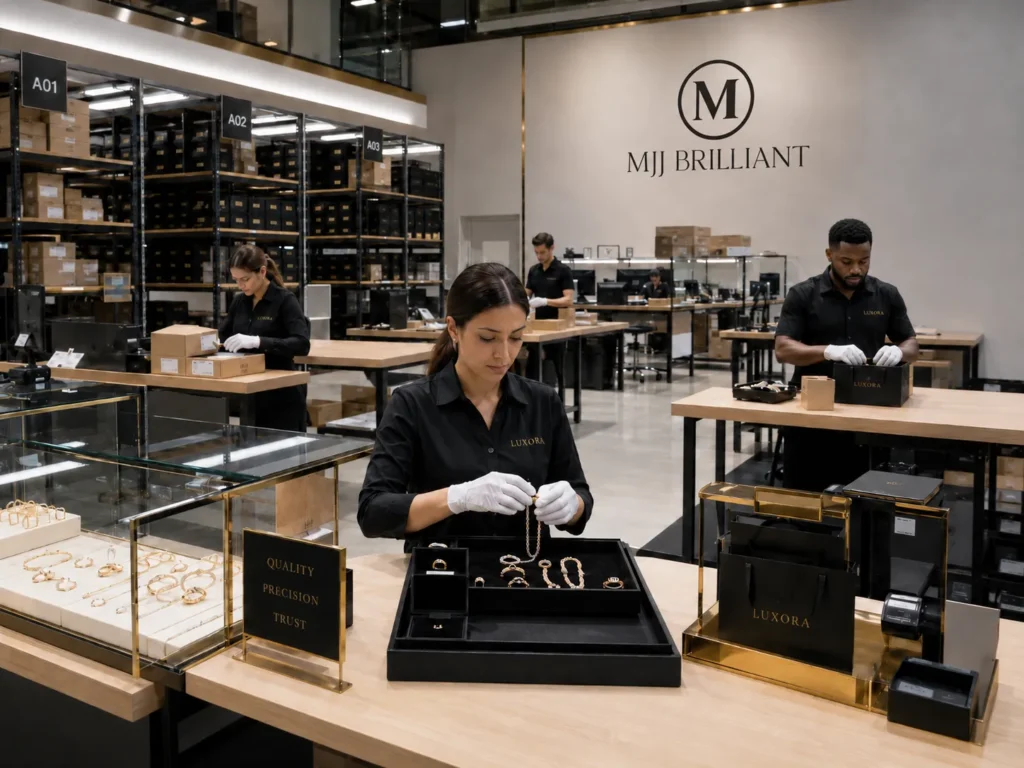
Once you start supplying retail chains or multi‑door independents, logistics becomes more complex than shipping boxes from your own store.
Routing guides and compliance
Each retailer comes with its own rules: preferred carriers, label formats, ASN requirements, and carton labeling. Non‑compliance creates immediate chargebacks. A partner experienced in jewelry brand distribution handles those requirements as a matter of routine.
EDI integration
Many mid‑tier and large retailers expect EDI for purchase orders, ASNs, and invoicing. A jewelry‑specific fulfillment partner that understands these flows can reduce manual work for your operations team and keep orders moving without re‑typing data.
Replenishment as a competitive edge
In a wholesale context, brands that replenish quickly tend to secure more floor space and buy‑ins. When manufacturing and distribution are integrated, retailer sell‑through data can directly trigger production and routing through our process, which combines both automated and manual elements.
We produce over 4 million pieces annually through a model designed for brands scaling nationwide: manufacturing in Mexico under USMCA‑aligned processes, paired with seamless U.S. distribution
Multi‑door routing
For brands with 10, 20, or 50 doors, correctly routing to each location is non‑trivial. A partner that already manages multi‑destination routing and compliance frees your team to focus on sell‑through, not shipping labels.
For a deeper dive into national expansion without new stores, see our piece on scaling a jewelry brand nationwide.
How to Evaluate a Jewelry Fulfillment Partner
When you evaluate a jewelry fulfillment partner, the criteria should be tighter than for a general 3PL. A simple checklist is often revealing:
- Fine jewelry experience – Do they have a track record with high‑value, small‑format inventory, or are they primarily an apparel or general‑merchandise warehouse?
- QC at intake and dispatch – Can they visually inspect and triage jewelry, or do they only count boxes?
- Branded packaging execution – Can they consistently execute your exact packaging requirements at any volume?
- Chain‑of‑custody – Do they offer item‑level tracking from receipt through dispatch?
- Wholesale compliance – Are they set up for EDI, routing guides, and retailer‑specific labeling and documentation?
- Returns triage – Do they inspect returned items before restocking or sending them for repair?
- Dropshipping capability – Can they support single‑unit, made‑to‑order fulfillment as well as bulk?
- Manufacturing integration – Is production under the same roof or tightly linked, or is there a handoff between factory and 3PL where details get lost?
- SLA transparency – Are production and fulfillment timelines documented and measurable?
If a prospective partner cannot answer yes to these questions, they are probably not built for fine jewelry.
Closing and Next Steps
Fine jewelry logistics is not a generic problem. It is a category‑specific discipline that touches security, brand experience, compliance, and growth. Brands that treat fulfillment and distribution as an afterthought — or hand them to partners who do not understand the category — pay for it in returns, chargebacks, damaged trust, and lost retail opportunities.
MJJ Brilliant’s integrated model—full‑service manufacturing, no‑MOQ production, USMCA‑aligned Mexico capacity, and jewelry‑specific fulfillment—was built to remove those risks from your plate and let you scale on one operational backbone instead of many.
Talk to MJJ about fulfillment or dropshipping support for your brand. Share your current order volume, channel mix, and biggest logistics pain point through our contact form, and we will outline what a partnership could look like for your next phase of growth.