You found a custom jewelry manufacturer. Their quality is solid. Then comes the conversation about minimums—500 units per style, 12 colorways, and upfront payment.
For most large‑scale manufacturers, high MOQs are a feature, not a bug: they keep their lines efficient, but they can quietly suffocate a growing jewelry brand’s cash flow and creativity.
More and more founders, boutique owners, and established brands launching new lines are deciding that the model no longer works.
They are choosing no‑minimum‑order jewelry manufacturing and made‑to‑order programs that let them place the right orders, not just the biggest ones.
The article breaks down why MOQs are a trap, the real cost of dead inventory, what a no‑MOQ model actually looks like at MJJ Brilliant, and why flexibility has become a strategic advantage—not a nice‑to‑have.
The MOQ Trap: How Minimums Hurt Growing Brands
Minimum order quantities are usually presented as non‑negotiable: “We can take you on, but we need at least 300–500 units per style.” From the factory’s perspective, this makes sense. MOQs help them:
- Fill casting trees and production lines efficiently.
- Amortize CAD, molds, and tooling across a larger batch.
- Reduce changeovers and scheduling complexity.
The logic works for them. It rarely works for a brand that’s testing a new design, a new category, or a new market. You’re forced into an uncomfortable choice:
- Over‑order to hit the minimum, tying up capital in stock you’re not sure will move.
- Skip the style entirely, limiting your assortment and slowing your growth.
For a small or emerging brand, that capital isn’t sitting in a separate “inventory experiment” fund. It’s the same money you need for marketing, photography, influencer partnerships, and covering operating expenses.
Ordering 300 units of a new style when you realistically expect to sell 80 over a season means months—sometimes a year or more—with cash sitting on the shelf instead of working for you.
There’s also trend risk. Jewelry has become increasingly trend‑driven and social‑led. A silhouette that’s hot in Q1 can be saturated or fade by Q3.
If you were forced into a 500‑unit MOQ on a trend‑forward design, you may still be sitting on half that stock when the market has moved on, leaving you to discount or warehouse a style that no longer reflects where your brand is headed.
Even established brands feel this pain when they launch new lines or experiment with materials and price points. Their aggregate volume might be healthy, but a new category—say, men’s jewelry or demi‑fine—still starts at zero. Traditional MOQs make it hard to run the low‑risk, test‑and‑learn product strategy that modern brands need.
The Real Cost of Dead Inventory
Most founders feel the emotional weight of dead stock; fewer sit down to calculate its full cost. It’s more than “some boxes in the back.”
Direct costs:
- Storage. Whether it’s a warehouse pallet, a stockroom shelf, or a spot in your boutique, unsold inventory occupies space you’re paying for. That footprint grows more expensive as you expand.
- Capital cost. Every unsold unit represents cash you can’t deploy elsewhere. That money could be funding your next photo shoot, a new landing page, or a small test of a potentially better‑selling design.
- Markdowns and clearance. When stock truly stalls, most brands liquidate at a steep discount—often recovering only a fraction of landed cost. At that point, you’ve effectively subsidized your manufacturer’s MOQ model with your own margin.
Indirect costs:
- Distraction. Your team spends time photographing, re‑merchandising, promoting, and discounting slow‑moving items instead of focusing on your best sellers and new developments.
- Brand dilution. Regular “fire sales” and constant markdowns teach customers to wait for a deal and erode the perceived value of your pieces—especially damaging in fine and semi‑fine segments.
- Stalled supplier relationship. When you’re sitting on overstock, you’re less likely to brief new styles with the same manufacturer, which freezes product development and makes your assortment feel stale.
Dead inventory isn’t just a storage issue. It’s a tax on every over‑order, every conservative forecast, and every MOQ you accepted just to keep the factory relationship alive.
What No‑MOQ Manufacturing Actually Looks Like
There’s a persistent myth that “no MOQ” means cottage‑industry production, slow timelines, or compromised quality. A properly designed no‑MOQ program looks very different.
In a made‑to‑order jewelry model, orders are placed for exactly the quantities the brand needs—driven by demand, not by the manufacturer’s minimums. That might be:
- 10 units of a new design to test on your site or with a key stockist.
- 40 units to restock a boutique after a good first read.
- 200 units of a style that’s scaling into multiple doors.
At MJJ Brilliant, those orders all run through the same infrastructure: commercial‑scale CAD and model making, casting, setting, finishing, and QC in our 100,000 sq ft USMCA‑compliant facility in Mexico, supported by over 700 master jewelers and a four‑million‑pieces‑per‑year capacity.
A 10‑piece order and a 500‑piece order are held to the same standard; the difference is that you decide the volume based on what your business can support.
Because production is in Mexico under USMCA, the logistics benefits apply regardless of size: duty‑free re‑entry into the U.S. and streamlined shipping back into U.S. territory. Flexible jewelry production does not mean “slow and far away”; it means on‑demand jewelry production integrated with serious capacity.
Under a no‑MOQ model, you can use production in several ways:
- New design prototypes and small market tests. One or a handful of samples to validate fit, look, and customer response before scaling.
- Limited edition and seasonal drops. Define your run upfront (for example, 50 or 100 units) and produce exactly that—no more, no less.
- Replenishment based on real sell‑through. Reorder only what’s needed, when it’s needed, instead of forecasting six months out to satisfy a minimum.
- New category pilots. Launch a capsule in a new metal, stone, or price tier without committing to warehouse‑sized quantities.
What doesn’t change is crucial: lead times remain consistent, QC processes are identical, and you receive the same account support on smaller orders as you do on larger ones.
Why Flexibility Is a Competitive Advantage
In a fast‑moving jewelry market, flexibility is no longer a convenience—it’s a competitive edge.
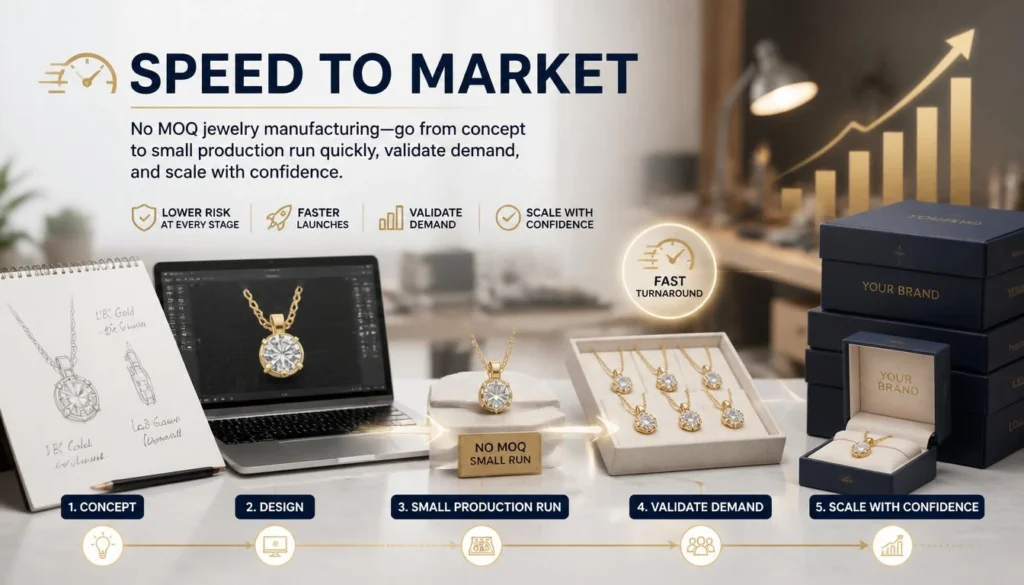
- Speed to market. With no MOQ jewelry manufacturing, you can move from concept to small production run quickly, validate demand, and then place larger follow‑up orders with confidence. That reduces risk at every stage of product development.
- Trend responsiveness. When you see a silhouette, motif, or stone color spiking, you can respond with a limited drop instead of waiting until you can justify a 300‑piece commitment. If the trend proves durable, you scale. If it doesn’t, you’ve taken a controlled risk.
- Assortment breadth. Without minimums forcing you into deep bets on a few styles, you can maintain a more interesting catalog—more SKUs across metals, stones, and price points—without flooding your balance sheet with inventory.
- Stronger partnerships. A no‑MOQ model supports an ongoing, iterative
relationship between brand and manufacturer: frequent, right‑sized orders rather than sporadic, anxiety‑inducing “big buys” dictated by the factory’s thresholds.
The brands growing fastest right now aren’t simply the ones placing the biggest orders. They’re the ones placing the right orders—backed by real demand data—and working with a manufacturer that’s flexible enough to match their pace.
Ready to Build Without Minimums?
Whether you’re testing your first original design, launching a new line, or trying to transition away from MOQ‑heavy suppliers, the structural barriers you’re facing are real—but they’re not inevitable. A no‑minimum‑order jewelry manufacturing model lets you scale on your terms, not your factory’s.
MJJ Brilliant offers exactly that: more than 40 years in the industry, 700+ master jewelers, USMCA‑compliant made‑to‑order production in Mexico, and no minimum requirements—designed specifically for brands that need flexibility without sacrificing quality or reliability.
Start your no‑MOQ production program—tell us about your brand and what you’re looking to build via our contact form.
Our expert team will respond with options tailored to where you are now—and where you want your brand to go next!