

Most people think launching a fine jewelry brand requires a studio, a bench jeweler on staff, a warehouse full of inventory, and a startup budget big enough to make the whole idea feel out of reach. The reality is that this is no longer true.
From our experience working with emerging brands, the ones moving fastest today are not the ones investing in the most infrastructure up front; they are the ones building lean, validating demand early, and working with the right production and fulfillment partners to stay flexible.
What changed is simple. On-demand manufacturing means a founder can launch with a tight collection rather than a deep-inventory bet.
E-commerce platforms make it possible to sell nationally or globally from day one without a retail lease. Social and paid digital channels let demand reveal itself before large production decisions are made.
And when fulfillment is built into the manufacturing model, there is no need to take on warehouse overhead before the business has earned it.
We see the strongest launches follow the same sequence: design smart, manufacture lean, sell early, fulfill without friction, then reinvest based on real demand. That is the framework.

Step 1: Design Smart, Not Big
The first mistake most new founders make is assuming that more SKUs create more opportunity. In practice, the opposite is usually true.
A strong launch collection should feel focused enough that a customer understands the brand point of view within seconds of landing on the site. That is why we recommend starting with three to six hero designs rather than trying to launch with thirty.
A smaller range is easier to photograph, easier to explain, easier to merchandise, and much less expensive to test. It also forces clarity. If the first collection cannot communicate a distinct aesthetic with a handful of pieces, adding more designs usually creates noise rather than momentum.
This is where CAD and 3D prototyping become important. Before casting anything at production scale, we can help founders review a design in physical form through CAD/CAM development and 3D-printed sampling.
That gives you a chance to refine proportions, prong profiles, stone placement, and metal weight before committing to a broader run. It is a faster and less risky way to make decisions, especially when every dollar in an early-stage brand matters.
We also encourage founders to design for the model they are actually using. If the first launch will be made-to-order or produced in small quantities, the collection should reflect that reality.
Clean rings, pendants, earrings, and other pieces that translate well into lean production are often smarter launch vehicles than highly complex, assembly-heavy styles. You can always expand into more technically demanding designs once demand is proven.
From day one, ownership matters. CAD files, design documentation, and production standards should be handled under NDA and clearly defined in the manufacturing agreement. Before any piece is produced, we sign an NDA to protect your intellectual property. Any CAD file created in‑house by the MJJ team is owned by you, the brand owner.
Here’s a quick launch-collection checklist: 3–6 SKUs, CAD/3D sample review, target metal/stone assumptions, target price points, and production constraints.
Step 2: Manufacture Without the Risk
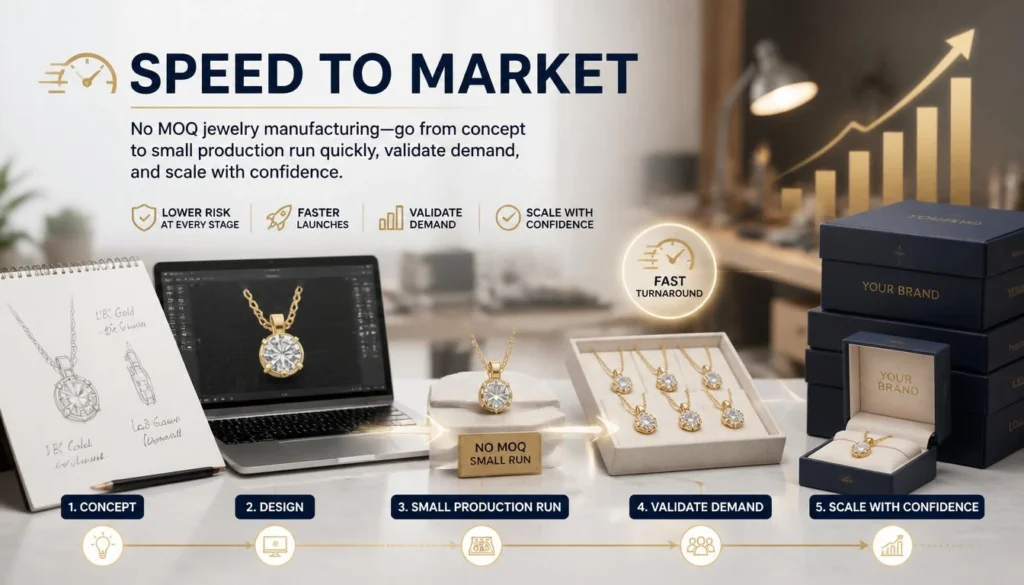
Traditional manufacturing breaks many jewelry startups before they even begin. The pattern is familiar: a factory asks for 200 to 500 units per style, a founder stretches to hit the minimum, and suddenly the business is carrying months of inventory before a single sales pattern has been validated.
That is why we believe no-MOQ, made-to-order production is one of the most important structural advantages available to a new brand. Instead of producing for a forecast, you produce for a launch plan. That could mean ten units of a test design, a small batch tied to a waitlist, or a narrow first run designed to generate actual sell-through data.
The difference is not just operational. It is financial. When capital is not tied up in excess inventory, it can be used where early brands need it most: product photography, content creation, packaging, paid social, founder storytelling, and customer acquisition. That is how a brand stays cash-aware without looking small.
At MJJ Brilliant, our made-to-order model is built to support that kind of launch. We can take a style from CAD through a finished piece, maintain the same quality standards whether the order is small or large, and support flexible replenishment as sales data comes in.
Instead of guessing which designs will work and committing deeply to all of them, a founder can launch five designs with fifteen units each, watch what moves, reorder what wins, and retire what does not. That is how product development becomes evidence-based instead of speculative.

Step 3: Sell Before You Scale
A fine jewelry brand does not need a perfect retail ecosystem to start. It needs a clean online flagship and a way to learn quickly.
For most founders, that means building on Shopify or another mature e-commerce platform that makes it easy to launch, manage content, and optimize for mobile.
The fundamentals matter more than complexity: strong product and jewelry-wearing model visuals, a coherent brand story, clear materials information, a simple checkout flow, trust signals, and policies that reduce hesitation.
We usually advise founders not to wait for every detail to be perfect. A soft launch to an email list, private customer group, or social audience will teach you more than months of internal debate. Real purchase behavior is the most valuable feedback loop you can get.
That is also where digital channels become a true operational tool, not just a marketing layer. Instagram and Pinterest help people discover products visually.
TikTok can make the design story and behind-the-scenes process feel much more authentic. Email captures intent and often drives the first wave of repeat purchases. Paid social, in turn, even at a modest budget, helps identify which pieces attract more clicks, saves, add-to-carts, and conversions.
In the first sixty days, we would rather see a founder learn which two designs customers actually want than build a larger catalog based on instinct alone. The goal of the launch is not perfection. The goal is a signal.
MJJ Brilliant partners with fine and demi‑fine brands, offering a wide range of materials and sourcing support. Our lead time is 2–3 weeks, and we also handle repair orders so you can stay focused on creating new products.

Step 4: Fulfill Without a Warehouse, Then Learn Fast
The other overhead trap is logistics. Renting space, storing inventory, packing orders, managing courier relationships, and handling returns can become a full-time job before the brand has enough revenue to justify it.
That is time the founder should be spending on product, brand building, and customer communication.
For early-stage brands, the leanest model is often a manufacturing partner that can also support fulfillment. MJJ Brilliant can do that.
That means the same relationship that helps produce the jewelry can also help move it efficiently to the customer, with branded packaging and a smoother operational handoff.
For some brands, dropship-style or on-demand fulfillment is the cleanest way to test new styles with minimal inventory risk.
For others, small-batch storage and replenishment support are enough. The important point is that the logistics layer should not force premature hiring or infrastructure.
This is also what makes a lean launch scalable. The same system that supports the first hundred orders can often support the first ten thousand, because the infrastructure already exists. Instead of rebuilding operations every time demand grows, the founder can focus on refining the assortment and increasing customer acquisition efficiency.
The model is straightforward: design a tight collection, produce in disciplined small quantities, launch online quickly, fulfill through a partner, then use real sales data to decide what comes next. Each step feeds the next.
That is how startups stop behaving like inventory businesses and start behaving like learning systems.
The infrastructure that once required years and major capital is now accessible much earlier, provided the operating model is right.
From first prototype through ongoing replenishment and fulfillment, we built MJJ Brilliant to support exactly that kind of lean launch so brands can scale stronger and with flexibility.
This includes QC before shipment, insured shipping, and handling your branded packaging. We also manage tracking, returns, and repair handoffs if customers decide to send back a piece.
Ready to build your first collection or test sample piece? Tell us about your brand and your vision through our contact form.
Prefer to talk it through? Book a free 20-minute call with our development team, and we will map out what a lean launch could look like for your designs, timeline, and target volume and price points.

