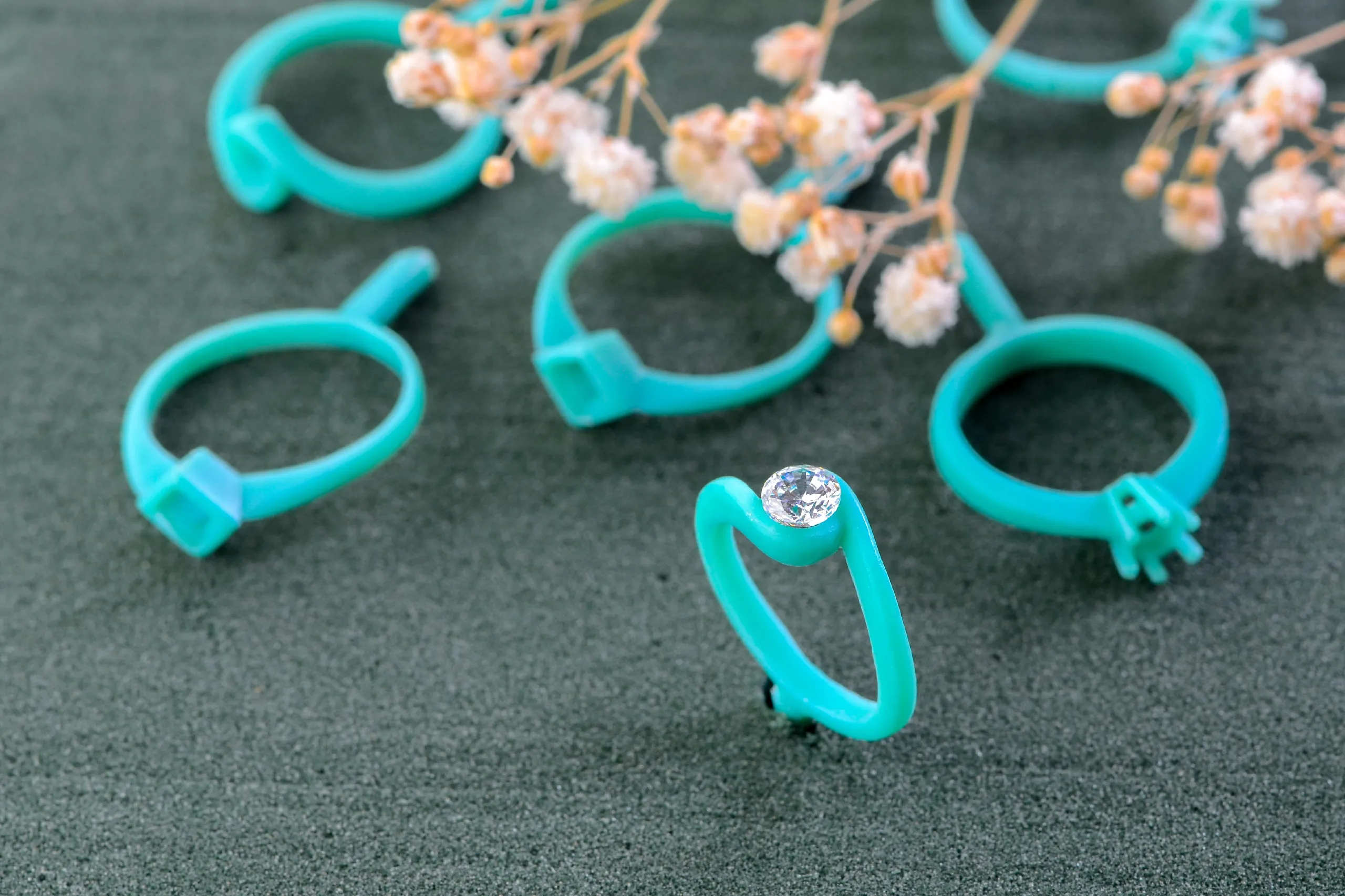
If you develop products for your jewelry brand, you already know the pain of slow prototypes: weeks waiting on a hand-carved model, back‑and‑forth adjustments, and a development calendar that feels permanently behind the trend curve.
3D jewelry printing changes that dynamic. Used correctly, it lets you see complex designs in hand within 3-5 business days, refine them quickly, and move into casting and production with much more confidence—and far less spend locked into tooling that might never go to market.
Below, we’ll walk through how we use 3D printing in real jewelry workflows, where it outperforms traditional methods, and when casting or handwork is still the better choice.
Wax and Resin 3D Printing for Jewelry Prototyping
In a modern atelier, 3D jewelry printing is rarely a standalone process; it’s one step in a tightly integrated CAD‑to‑casting pipeline.
The flow typically looks like this:
- CAD Design
Your design team (or ours) builds a 3D model of the piece in CAD, with all the functional details included: prong thickness, under‑gallery structure, stone seats, metal thickness, ring size, and tolerances. - Wax or Resin Printing
From that file, we print the design in either castable wax or specialized resin:
- Wax printing jewelry is ideal when the printed part will be used directly in lost‑wax casting. Systems like Solidscape or B9Creations are widely used for their precision in producing cast‑ready models.
- Resin printing jewelry prototyping is often used for visual and fit samples, or for masters that will then be molded. High‑resolution DLP and SLA resin printers (such as those from Formlabs) deliver crisp detail that makes evaluating pavé layouts or halo proportions far more accurate.
- Wax printing jewelry is ideal when the printed part will be used directly in lost‑wax casting. Systems like Solidscape or B9Creations are widely used for their precision in producing cast‑ready models.
- Physical Review
The printed piece lets your team:- Check proportions, wearability, and finger coverage.
- Evaluate how pavé or halos read at the actual scale.
- Confirm details like gallery height and shank width.
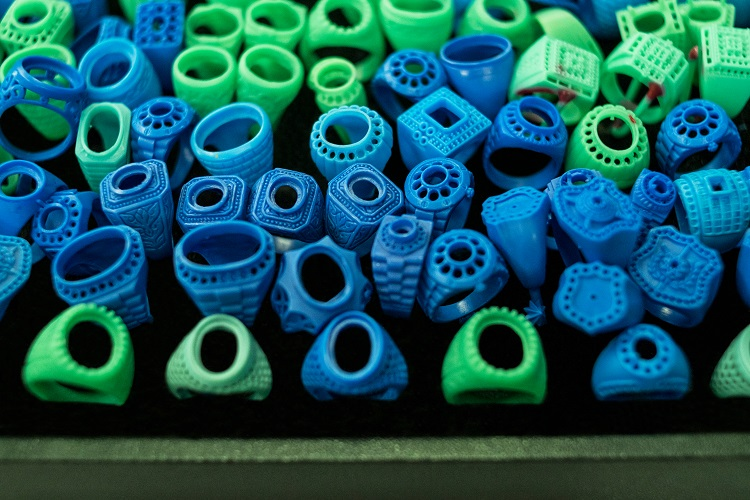
Instead of trying to judge a design from screen renders or 2D drawings, you’re holding it in your hand within a few days. That alone eliminates a huge amount of ambiguity from the development process.
How 3D Jewelry Printing Fits Into Casting and Sample Approval
3D printing doesn’t replace casting—it feeds into it.
Here’s how it usually slots into a casting workflow:
- Step 1: CAD Approval
You review screenshots, turntables, or a digital 3D viewer and sign off on the CAD. - Step 2: Printed Prototype
We print the model in wax or resin and either:
- Use it as a direct burnout pattern for casting (for one‑off and small runs), or
- Use it to create a silicone or rubber mold that will be injected with wax for repeated production.
- Step 3: First Metal Sample
We cast the printed model in your chosen metal, finish it, set stones if required, and deliver a first article sample. - Step 4: Final Adjustments
Any changes—slightly thicker prongs, a lower profile, tighter halo—are made at the CAD level. A new print-and-cast sample follows, without the need to remake hand tooling from scratch.
For product teams, the key benefit is control. You know that the geometry moving into production is tied directly to a versionable, documented, and reusable file. That gives you more consistency across reorders, seasons, and even different manufacturing locations.
3D Printing vs. Traditional Hand Models and Tooling
Hand carving and traditional model making still have their place, but they come with inherent constraints:
- In our experience, a complex, hand‑carved master can take 1–3 weeks to produce.
- Any significant change often means re‑carving or heavily modifying the original.
- Very intricate or asymmetrical pieces can be difficult or impossible to execute precisely by hand.
By contrast, a CAD‑based 3D jewelry printing workflow offers:
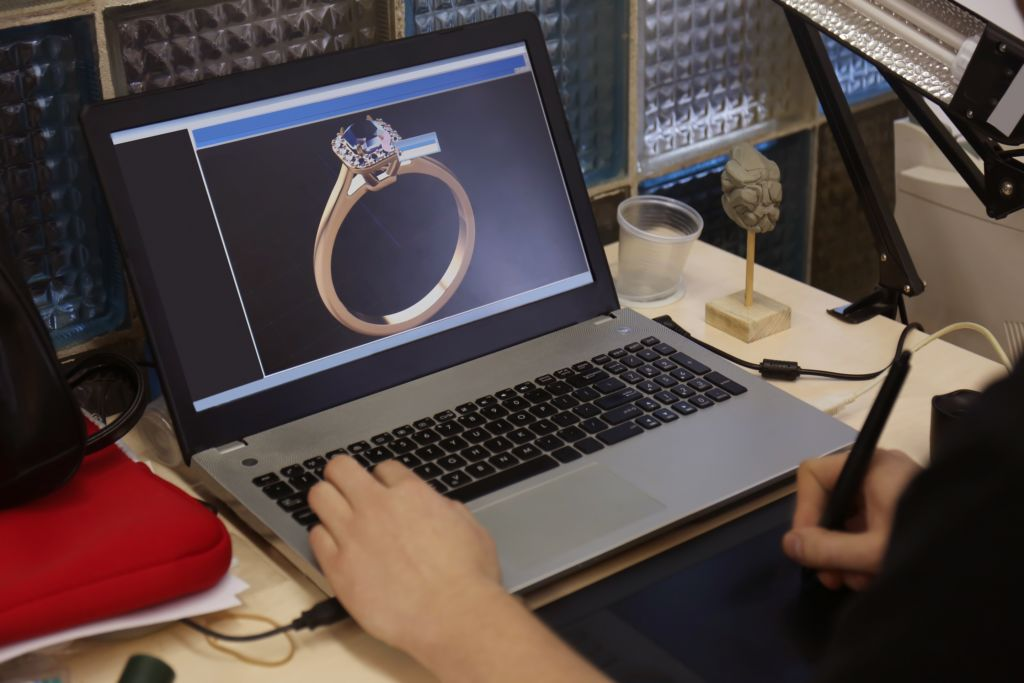
- Faster iterations – CAD revisions are often turned in days, with new prints following quickly.
- Higher symmetry and repeatability – Mirror‑image earrings, matched bands, or multi‑stone halos come out perfectly balanced.
- Greater design freedom – Organic, pierced, or lattice structures that would be labor‑intensive to carve can be modeled and printed with relative ease.
For many brands, the real-time savings are not just in the first sample, but in how quickly you can move from “Version 1” to “Version 3 or 4” without resetting the clock.
Cost and Speed Advantages for New Collection Development
3D jewelry printing affects your development budget in three main ways:
- Lower upfront tooling risk
Traditional development often meant paying for full tooling and model making before you knew whether a design would justify the investment. With 3D printing, you can:
- Commission a CAD design with us for around $150 USD (complex pieces will be more).
- Order printed or cast samples starting at around $75 USD per style (prices vary by size, complexity, and metal).
That gives you a much cheaper way to validate designs before committing to molds, large stone buys, or full production runs.
- Commission a CAD design with us for around $150 USD (complex pieces will be more).
- Faster go/no‑go decisions
Because you get physical samples faster, you can:
- Present more options in line reviews.
- Use real pieces in photoshoots and sell‑in decks.
- Get retailer feedback earlier in the calendar.
This shortens the distance between concept and market‑ready SKU.
- Better allocation of design resources
When CAD and printing workflows are efficient, your team can test more ideas without getting bogged down in manual benchwork. That means more room to experiment with complex or differentiated designs that set your brand apart.
Direct Metal Printing vs. Casting: When Each Makes Sense
There are two broad categories in additive manufacturing for jewelry:
- Indirect printing (wax/resin → casting)
This is what most brands use today. The print is a pattern; the final piece is still cast in metal using traditional lost‑wax methods. - Direct metal printing (DMP)
Here, the printer builds the piece layer by layer directly in metal—often stainless steel or precious-metal alloys—using laser sintering or similar technologies.
Direct metal printing sounds like the future, but it’s not the best fit for every project, as the process itself is definitely more time-consuming.
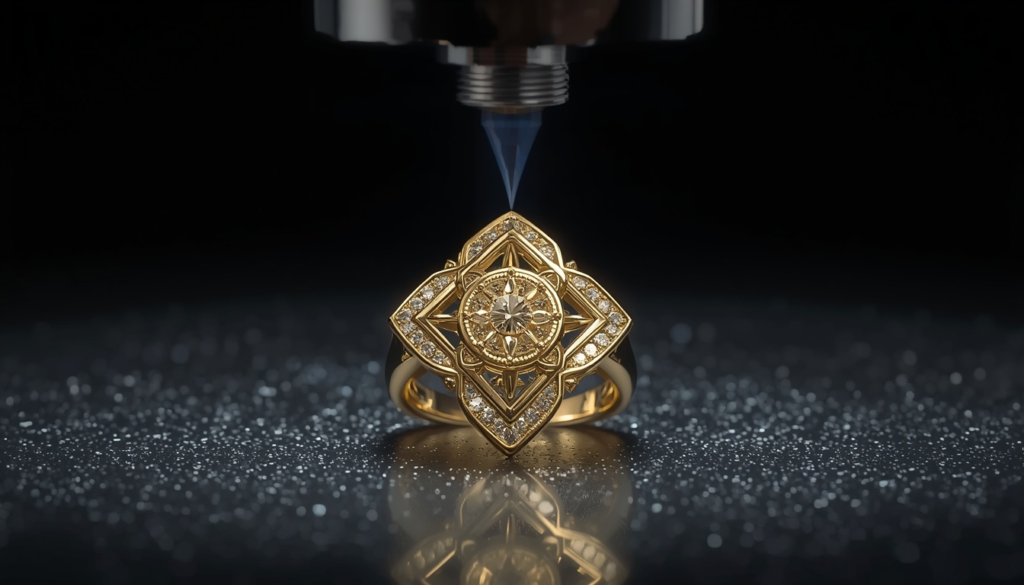
Here’s how we think about it:
Direct metal printing is useful when:
- You need a very small batch of highly complex pieces where traditional casting and finishing would be prohibitive.
- The design incorporates internal structures or geometries that cannot be created with standard molds.
- You’re producing prototypes that must perform like final metal pieces under load or wear tests.
Traditional casting (fed by 3D printed patterns) is better when:
- You’re developing designs that will go into ongoing production or sizeable runs.
- You need a wider choice of alloys and karatages at a predictable cost.
- You care about industry‑standard surface quality and finishing workflows.
For most brands, indirect 3D jewelry printing + casting hits the sweet spot: you get the speed and precision of additive manufacturing with the proven economics and metal options of conventional casting.
Why Your Brand Should Care—Now
If you’re responsible for getting new collections to market on time and on budget, 3D jewelry printing is less about technology and more about leverage:
- More designs tested, faster – You can explore bolder silhouettes and more intricate structures without committing to full tooling.
- Fewer unpleasant surprises – You see proportions, comfort, and stone behavior in real life, not just on a screen.
Looking ahead, AI-assisted CAD tools and faster direct metal printing are compressing timelines even further — brands that build these workflows into their development process now will have a meaningful head start when those become standard.
If you’re exploring 3D jewelry printing for your upcoming collections, we can help you translate sketches or concepts into production‑ready prototypes.
MJJ Brilliant manufactures for national retailers and emerging brands across North America, as well as European brands seeking to break into the U.S. market but struggling to find a reliable partner. That’s us!
Use the form below to send us your sketch, and we'll get back to you in 24 hours with a CAD timeline and pricing.
Contact